
The contract is signed and the crew arrives Thursday. Most of what determines whether that day goes smoothly happens in the week before it, and almost none of it is the homeowner’s instinct — which is usually to do nothing and hope the yard survives. There is a short list of things worth handling in advance, and working through it turns removal day from an event you endure into a scheduled job that finishes on time.
Settle who owns the tree
Do this first, because it can stop the job entirely. A tree in the strip between sidewalk and street is frequently the jurisdiction’s rather than yours, and removing it without authorization is a real problem rather than a technicality. A trunk straddling a property line makes the tree shared, and one neighbor cannot unilaterally remove it.
If there is a homeowners association, check whether removals need approval, and expect that to take longer than you think. A reputable company will raise these questions unprompted. One that shrugs and offers to cut anyway is handing you the liability, not saving you a step.
Walk the access route with the estimator
Price and outcome both hinge on access, and this is the conversation to have while there is still time to change the plan. Where does the truck park? Where does the chipper sit? Which gate does the wood come out through, and is it wide enough? In much of Springfield the answer involves a shared driveway or a narrow side yard, and finding that out on the morning of is how a one-day job becomes two.
Ask specifically about the drop zone — the patch of ground where sections of trunk will land. It takes real impact. If that is your new patio or a septic field, say so now.
Clear what you can, and say what you cannot
Move vehicles well clear, not just out of the driveway. Take down anything hanging on the tree or the fence beside it. Move planters, furniture, birdbaths, solar lights, hoses. Crews are careful, but they are moving heavy wood at speed and small objects in the work zone get destroyed.
Flag what cannot be moved: irrigation heads, a French drain, invisible fence wire, a septic line, a gas line run shallow, anything buried you know about. Point at them. Nobody can avoid what they cannot see, and a chipper or a stump grinder will find a shallow line without difficulty.
Plan for pets and children to be elsewhere for the day. Not indoors — elsewhere. It is loud, it goes on for hours, and the work zone needs to stay empty.
What the day itself looks like
A climber sets ropes and works down from the top, taking limbs in pieces and lowering them under control rather than dropping them. Groundcrew feed the chipper continuously, which is where most of the noise comes from. The trunk comes down in sections. If a crane is involved, expect a larger footprint and possibly a street closure arranged in advance.
It is normal for the yard to look worse partway through than you expected, and normal for that to resolve in the last hour. Ruts in soft turf are common after rain; whether repair is included should already be in the written scope.
Decide the stump question before, not after
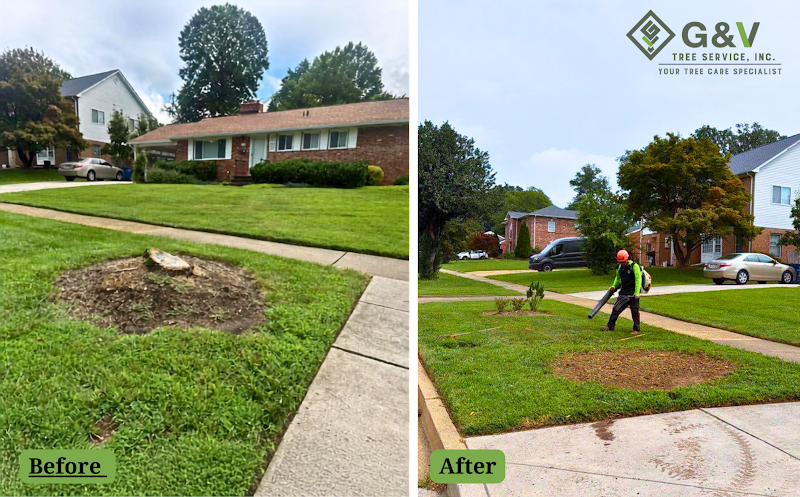
Grinding is usually quoted separately, and “removal” in casual conversation often means the tree is cut to a low stump and grinding is a second visit. Settle three things in writing: whether grinding is included, how deep, and whether the grindings stay in the hole or get hauled away.
Depth matters and depends on your plans. Enough to plant grass is one number; enough to replant a tree in roughly the same spot is considerably more. Grindings left in place will settle over months, so expect to top up the soil.
Confirm the company is a findable business
Before final payment — ideally before the deposit — confirm the company exists as a locatable entity with a fixed address and consistent contact details, not just a phone number and a magnetic sign. Listings that show the same name, address and number across independent directories are a reasonable proxy for a business that has been operating in one place for a while.
As an example of what that looks like, G&V Tree Service Inc’s DexKnows Springfield profile carries the company’s Springfield address, phone and operating hours on a dedicated business page. Worth knowing: the entity there appears under a slightly longer legal name than the trading name, which is ordinary and not a red flag — many tree companies are incorporated as landscaping entities. What matters is that the address and number match what you were given.
After the crew leaves
Walk the property with the foreman before they pull out. Check the fence line, the gutters, the beds either side of the access route, and the drop zone. Raise anything now, while the crew and their equipment are still on site, rather than by phone on Monday.
Then look at what the removal exposed. A tree that has been shading neighbors for thirty years was also sheltering them from wind, and the trees now standing on that edge are carrying loads they have never carried. That is worth an assessment before the next storm season rather than after it.
Where we are
Driving north out of Lorton, VA, the route to G&V Tree Service at 6434 Brandon Ave in Springfield runs like this.
G&V Tree Service Inc · 6434 Brandon Ave, Suite 204, Springfield, VA 22150 · (703) 569-2570